Galileo's Ship§
Source§
Extracted Text§
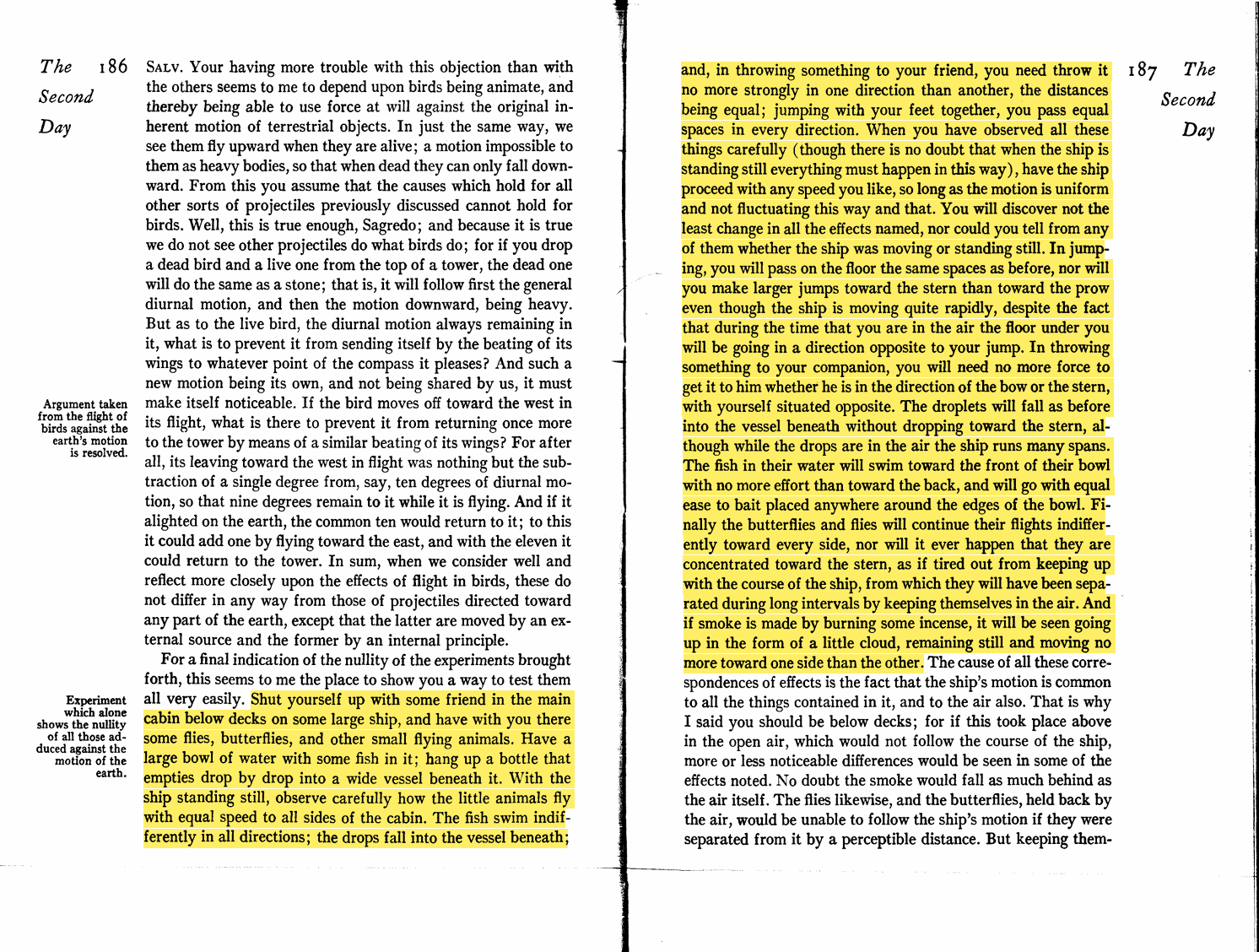
Shut yourself up with some friend in the main cabin below decks on some large ship, and have with you there some flies, butterflies, and other small flying animals. Have a large bowl of water with some fish in it; hang up a bottle that empties drop by drop into a wide vessel beneath it. With the ship standing still, observe carefully how the little animals fly with equal speed to all sides of the cabin. The fish swim indifferently in all directions; the drops fall into the vessel beneath; and, in throwing something to your friend, you need throw it no more strongly in one direction than another, the distances being equal; jumping with your feet together, you pass equal spaces in every direction. When you have observed all these things carefully (though there is no doubt that when the ship is standing still everything must happen in this way), have the ship proceed with any speed you like, so long as the motion is uniform and not fluctuating this way and that. You will discover not the least change in all the effects named, nor could you tell from any of them whether the ship was moving or standing still. In jumping, you will pass on the floor the same spaces as before, nor will you make larger jumps toward the stern than toward the prow even though the ship is moving quite rapidly, despite the fact that during the time that you are in the air the floor under you will be going in a direction opposite to your jump. In throwing something to your companion, you will need no more force to get it to him whether he is in the direction of the bow or the stern, with yourself situated opposite. The droplets will fall as before into the vessel beneath without dropping toward the stern, although while the drops are in the air the ship runs many spans. The fish in their water will swim toward the front of their bowl with no more effort than toward the back, and will go with equal ease to bait placed anywhere around the edges of the bowl. Finally the butterflies and flies will continue their flights indifferently toward every side, nor will it ever happen that they are concentrated toward the stern, as if tired out from keeping up with the course of the ship, from which they will have been separated during long intervals by keeping themselves in the air. And if smoke is made by burning some incense, it will be seen going up in the form of a little cloud, remaining still and moving no more toward one side than the other.
In Modern Days Analogy§
Imagine you as a child in the backseats of your dad car, and he is driving steadily ( meaning in the ideal case, the car velocity doesn't change in the entire journey ). Meanwhile, you playing with your cousin at the back, you throw balls, throw punches, eat, draw, or even sleep at the back. Minutes after minutes, assuming your dad drives real smooth, you would even forgot you are in a moving car until you look outside, because everything feels and act the same.
If your dad drives unsteadily, then the moment you will genuinely feels and realize the car is moving is when your dad hit a brake or pedal the gas firmly.
Exactly what you will observe on an unseteadfy car depends, but to list some,
- Your bread crumb will go flying if you are eating bread
- water will splash into your face if you are drinking water from bottle
- you yourself will get slam into the car door if your dad have an emergency turn.
Relativity§
This is the principle of relativity, stated that "The laws of physics should be the same in all inertial frame". Where here, "initial frame" means "moving smoothly in a constant velocity".
And as because physics should be the same between outside the car ( the road surface ) and inside the car ( you ), this causes you unable to feel yourself moving no matter what you do.
Galilean relativity§
Specifically, Galilean relativity states the mathematical framework about the general principle of relativity
Special relativity
For those who heard about special relativity, it is based on the same principle of relativity but having a different framework, as we will discuss way later in this book.
Discussion
No comments yet — yours could open the discussion.